
Quick Summary
For at home self defense boxing, buy gloves, hand wraps, a heavy bag, and leave enough floor space to move your feet. Gloves and wraps come first because they protect the hands you cannot replace, and the heavy bag is the centerpiece of home training. Add a jump rope for footwork and cardio, and treat focus mitts as optional partner gear.
Gloves and hand wraps are essential and should be your first purchase.
A freestanding bag suits renters, but it can slide on hard floors.
Hang a heavy bag from structural members, never drywall alone.
Run three sessions a week of roughly 30 to 40 minutes each.
Keep rounds at three minutes with one minute of rest.
Boxing Equipment for Home Training: What Actually Earns Its Space
Most beginners buy too much gear and train too little. Garages often end up stacked with unused equipment while the fundamentals go unpracticed.
Self defense boxing is the practice of using boxing's core strikes, footwork, and defensive movement to protect yourself and create distance, trained with real technique rather than choreography.
Here is what earns its place in a home gym:
| Equipment | Purpose | Priority |
| Boxing gloves | Hand and knuckle protection | Essential |
| Hand wraps | Wrist and knuckle support | Essential |
| Heavy bag | Punching power and conditioning | Essential |
| Jump rope | Footwork and cardio | High value |
| Focus mitts | Partner drills and accuracy | Optional |
Below, we break down each purchase, the mistakes that waste money, and an eight-week plan to actually use what you buy.
Boxing Gloves and Hand Wraps: Your First and Most Important Purchase
Gloves and wraps protect your hands, and your hands are the only equipment you cannot replace.
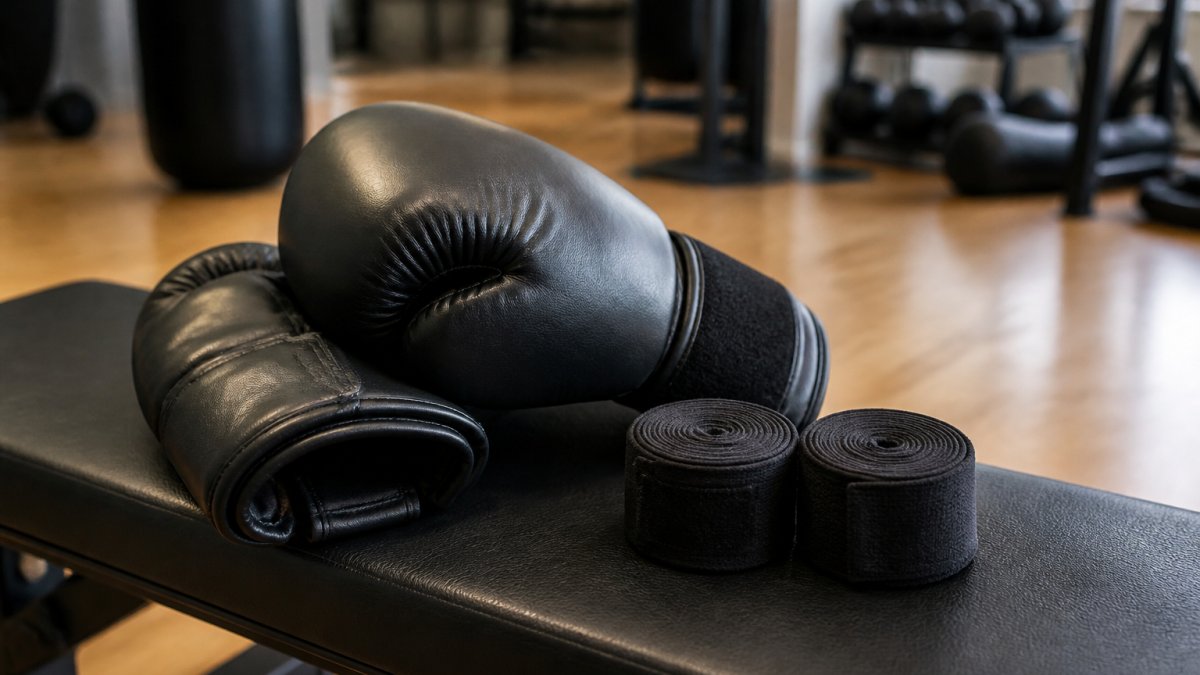
For home training, gloves are commonly chosen by weight, and heavier gloves add protection for bag work and partner drills.
Hand wraps matter more than beginners expect. A proper wrap supports the wrist and helps keep the knuckles in line.
If you are still deciding between models, our guide to the best boxing gloves for self defense training breaks down what to look for. Once yours arrive, check our walkthrough on how to tell if boxing gloves fit correctly before your first session.
Watch out: wrapping too loose defeats the purpose, and wrapping too tight can restrict circulation.
Choosing a Heavy Bag for Home Boxing Without Wrecking Your Floor
The heavy bag is the centerpiece of home boxing, and it is also where beginners can make costly mistakes. A bag that is too light swings wildly, one that is too heavy strains your joints and your mount, and one hung from the wrong structure is a genuine hazard. Proper installation and selection of this equipment establish the foundation for safe boxing for beginners, ensuring that your technique develops without the interference of faulty gear.
Freestanding vs. hanging: the real trade-offs
Freestanding bags need no mounting and suit renters or anyone short on space, but they can slide on hard floors under heavy combinations. Hanging bags swing more naturally, but require a ceiling mount or stand plus clearance to move.
A practical rule for home setups: if you cannot anchor to structure, a freestanding bag is the safer choice, though it suits movement and volume work more than full-power single shots.
Sizing the bag to the space and the user
Bag weight should match the user, not the ego. Bag weight should be matched to the user's body weight and experience, and the right size depends on your space and mounting options.
Length matters too. A longer bag gives you body-shot targets and a more natural swing, while a shorter bag is easier to hang in low ceilings. Measure your ceiling height before you buy, then subtract the mount, chain, and swivel.
Anchoring a hanging bag safely
A heavy bag should hang from structural members rather than drywall alone. Ceiling joists, a steel beam, or a purpose-built heavy-bag stand are common options for carrying the load. If you are unsure what is above you, find out before you drill.
Ceiling mount: Use a heavy-bag bracket rated for well above the bag's weight, and bolt into structure. Add a swivel so the chain does not twist.
Stand: A freestanding heavy-bag stand avoids drilling entirely and suits renters, but check its weight rating and footprint against your space.
Chain and hardware: Inspect the chain, swivel, and carabiner before every session. Replace worn links rather than trusting them.
Watch Out A heavy bag that fails mid-punch is a genuine hazard. If the mount flexes, the chain looks stretched, or the bag has shifted after a session, stop and re-check the hardware before you throw another punch.
Clearance and floor protection
Give yourself clearance on every side of the bag so you can circle, pivot, and step back without clipping furniture or a wall. For a hanging bag, allow extra space in the direction it swings.
Protect the floor under a freestanding base with a rubber mat or a piece of plywood, especially on hardwood or laminate, where a sliding base can scuff and gouge.
Filling and maintaining a freestanding base
Fill a freestanding base following the manufacturer's guidance. Water is convenient but can leak; sand is heavier and more stable but harder to move.
Inspect a hanging bag's mount and chains before every session, and check the bag's stitching and fill over time. A bag that has gone soft or lumpy changes how it absorbs impact, which changes how your hands feel after training.
Answer those honestly and you can avoid buying a bag your space cannot safely hold.
Boxing Footwork Drills at Home: The Skill Most Beginners Skip
Footwork is the skill that separates self defense boxing from swinging at a bag, and it is easy for beginners to neglect.