
Quick Summary
Pairing boxing self defense with a grappling art like Brazilian jiu-jitsu or wrestling closes boxing's biggest gaps. Boxing covers distance and punching, while grappling covers the clinch and ground, so you survive every range of a real confrontation.
Real confrontations pass through four ranges: striking, clinch, takedown, and ground.
Boxing and BJJ is the most practical pairing for most people.
Boxing and wrestling is the strongest pairing against the takedown threat.
Train the transition phase so switching ranges becomes automatic under pressure.
Self-defense authority ends when the threat ends, so break contact and create distance.
Why Boxing Alone Leaves Gaps in Real-World Self-Defense
Boxing is one of the best striking systems on earth. It also has a blind spot, and pretending otherwise gets people hurt. No single art covers every range of a real fight.
A boxer trains to punch, move, and defend at distance. That skill set is real. The gap shows up when the fight leaves that range.
The Limitations of Combat Sports in Non-Consensual Violence
Combat sports are governed by rules. Street violence has none. There is no referee, no weight class, no bell, and no one stopping the action when you hit the ground.
Opponents can grab, tackle, or headbutt
Fights can involve more than one attacker
Weapons change everything
A common mistake is assuming ring success equals street readiness. Readers weighing boxing against other disciplines can see a direct comparison of boxing vs MMA for self-defense. It does not.
Situational Awareness and De-Escalation Come First
The best fight is the one you never have. Situational awareness and de-escalation sit above every technique you will ever learn.
Scan your surroundings. Keep distance from strangers acting oddly. Use your voice to calm a situation before it escalates. Walk away when you can.
Conflict avoidance is not cowardice. It is the highest-level self-protection skill, and it costs nothing to practice.
The Best Martial Arts Combination for Self-Defense
The best martial arts combination for self-defense pairs a striking art with a grappling art.
That pairing closes the biggest gaps. Most real confrontations pass through four ranges: striking, clinch, takedown, and ground.
Striking alone leaves you exposed if you get grabbed.
The key is not collecting belts.
The article pairs a striking art with a grappling art to cover every range a real confrontation can pass through.
| Combination | Best for | Key difference |
| Boxing and Brazilian jiu-jitsu | Most people; ground fighting and submissions | Boxing handles stand-up, BJJ handles the ground |
| Boxing and wrestling | The takedown threat | Wrestling keeps you on your feet and controls the clinch |
| Boxing alone | Distance and punching | Leaves you exposed if you get grabbed |
| Grappling alone | Clinch and ground | Leaves you exposed to punches on the way in |
Boxing and Brazilian Jiu-Jitsu: Striking Meets Ground Fighting
Boxing and Brazilian jiu-jitsu is the most practical pairing for most people. Boxing handles the stand-up.
The synergy is simple. Your boxing keeps the attacker at distance and buys time.
Watch out: BJJ classes often start from the knees or a seated position. Real fights start standing.
Boxing: punching mechanics, footwork, distance management
BJJ: ground control, escapes, submissions
Together: full-range coverage
Many students find this combo builds confidence fast because each art reinforces the other.
Boxing and Wrestling: Clinch Work and Take-Down Defense
Boxing and wrestling is the strongest pairing for one specific threat: the takedown. Wrestling teaches you to stay on your feet, defend shots, and control the clinch.
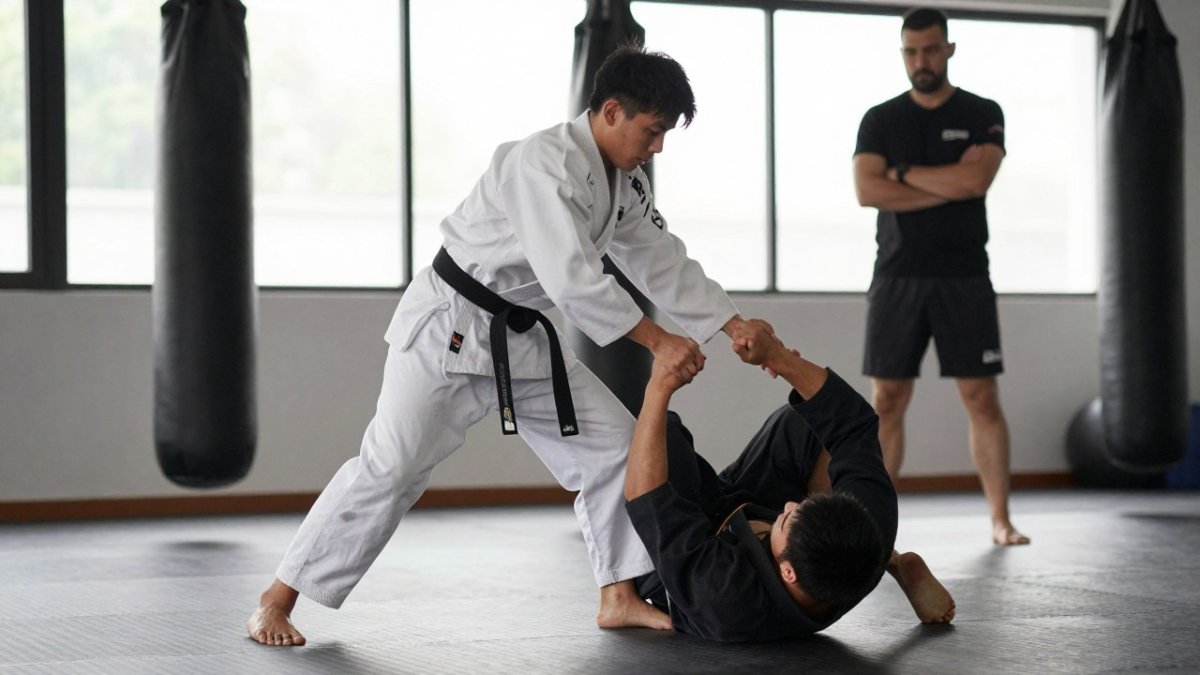
That matters because most street fights close fast. An attacker who grabs you or shoots for your legs is not playing by boxing rules.
Sprawl to stop a takedown
Clinch work to control posture
Sprawls and underhooks to stay upright
The trade-off is intensity. Practical guidance on how to recover after intense boxing training can help you keep hybrid training sustainable.
How to Combine Martial Arts Training Without Breaking Your Body
How to combine martial arts training comes down to scheduling, not willpower. Most people overtrain in month one and quit by month three.
A common approach is to start with a small number of sessions per week and add more once recovery keeps pace.
Alternate hard and easy days
Keep one full rest day
Sleep and eat enough to recover
Martial arts cross-training works when it is sustainable. The goal is combat readiness over years, not a single month of exhaustion.
Practical Integration Drills for Hybrid Training
Practical integration drills teach your body to switch ranges under pressure. This is where martial arts synergy becomes real.
Strike-to-sprawl: throw a combo, then sprawl on command
Clinch entry: box at range, then close to clinch on a cue
Wall work: defend a takedown against a wall
Pressure testing with a partner is essential. For a concrete guide to practicing boxing self-defense with a partner, see the partner drill walkthrough.