

Quick Summary
Boxing gets you competent faster, while MMA prepares you for more situations. The boxing vs MMA choice comes down to matching the style to the threats you actually face, since boxing teaches hard hitting and avoiding punches while MMA adds grappling, clinching, and ground survival.
Boxing produces usable skill in months, not years, for consistent beginners.
MMA splits training hours across striking and grappling, so baseline competence can take a year or more.
Train twice weekly for boxing basics in 4-6 months; three times weekly cuts it to 3-4 months.
Boxing wins at punching range, MMA wins against grabs, clinches, and takedowns.
Neither style handles weapons or multiple attackers; escape training matters more than style.
Boxing vs MMA for Self-Defense: The Core Trade-Off
The short answer: boxing teaches you to hit hard and avoid getting hit, while MMA adds grappling, clinching, and ground survival to the mix. If your goal is practical self-defense, the trade-off is simple: boxing gets you competent faster, MMA prepares you for more situations. At Man of War Boxing & Fitness, we coach both beginners and competitive athletes, and we tell every new student the same thing. Pick the style that matches the threats you actually face, not the one that looks best on television.
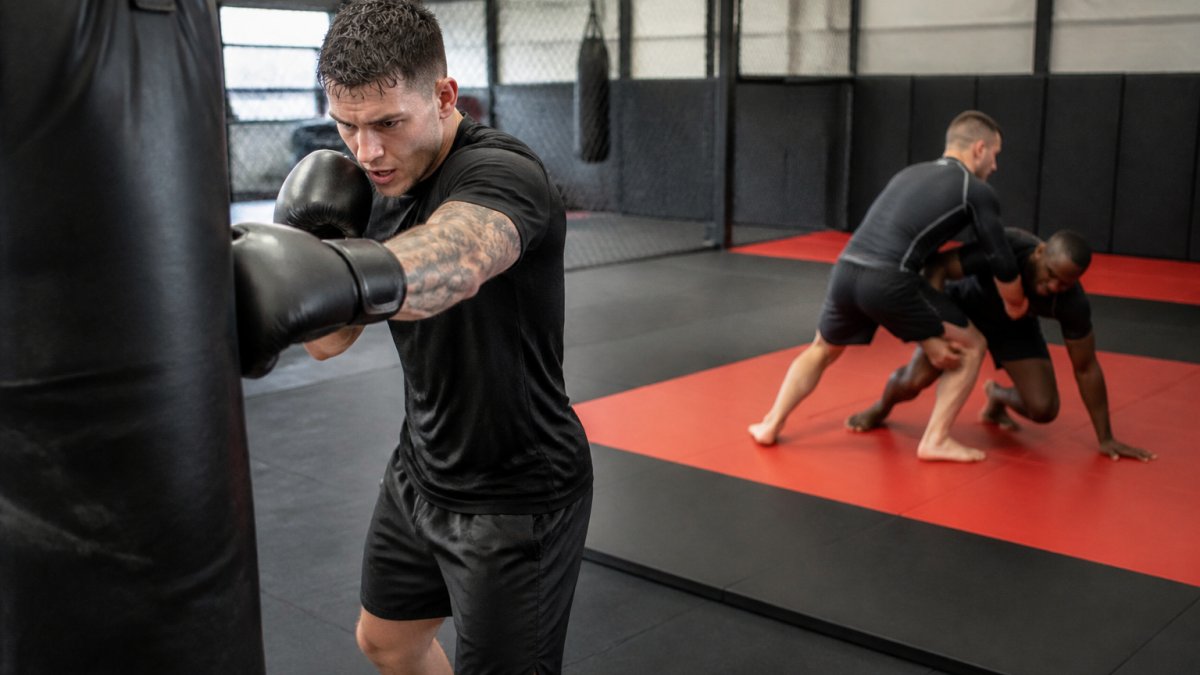
Consistent training requires reliable equipment to protect your hands during heavy bag work, making the selection of
a foundational decision for any serious practitioner.
What Each Style Actually Trains
Boxing is a striking art built on four punches, footwork, head movement, and distance management. Every round teaches you to control range and land clean shots while staying defensively responsible.
MMA combines striking with grappling, clinch work, takedowns, and ground fighting. The broader toolset means more to learn and more to maintain. Neither style is complete on its own, and honest coaches admit that.
Boxing for Self-Defense: Strengths and Blind Spots
Boxing's biggest strength is that it produces usable skill fast. A beginner who trains consistently can throw a competent combination and defend their head within months, not years. Punching is the most natural first response under stress, and boxing drills it until it becomes reflex.
The blind spots are real, though. Boxing training alone does not address a tackle, a clinch, or a weapon. If an attacker closes the distance and grabs you, pure boxing training leaves you improvising. Watch out: students who only box often stand too square in close range because nothing in the sport punishes it.
For partner drilling that sharpens this side of your game, see how to practice boxing self defense with a partner.
MMA for Self-Defense: Wider Toolset, Higher Learning Curve
MMA covers more ground because it borrows from Muay Thai, Brazilian jiu-jitsu, wrestling, and boxing. That versatility matters when a fight goes somewhere you did not plan. You learn to strike, clinch, take the fight down, and get back to your feet.
Boxing Or MMA? | Breakdown!
Combat Central
The cost is time. Splitting training hours across striking and grappling slows progress in each. Building baseline competence can take a year or more for many beginners.
Best for: students who want the broadest skill set and can train several days a week. Skip if: you need practical competence quickly or train once or twice weekly.
Self-Defense Training vs Fighting: Why the Gym Is Not the Street
A gym is a controlled environment: padded mats, agreed-upon rules, a referee, weight classes, and a reset after every exchange. The street has none of that. Self-defense training vs fighting comes down to this: sport fighting teaches you to win a fair one-on-one contest, while self-defense teaches you to escape an unpredictable encounter. That distinction is not philosophical, it changes what you practice.
What the Gym Trains You to Ignore
Combat sports quietly remove the variables that make real encounters dangerous:
Weapons. Neither boxing nor MMA sparring includes knives, guns, or blunt objects. A punch-first response to a drawn weapon is a losing plan. If a weapon appears, the priority is distance and escape, not engagement.
Hard surfaces. Gym floors are forgiving. Concrete, curbs, stairs, and furniture turn a routine takedown into a head injury. MMA's ground game assumes a mat; the real world assumes pavement.
Bystanders and confined spaces. A bar, a stairwell, or a crowded sidewalk removes the circling footwork boxing relies on. You may have no room to move offline.
Multiple attackers. Sport rules guarantee one opponent. Real encounters do not. Training that assumes a single adversary can build habits that fail when a second person enters the frame.
The legal aftermath. Use-of-force rules vary by jurisdiction. Escalating a confrontation or continuing after a threat ends can create legal exposure. Review your state's official use-of-force rules before you ever need them.
Escape-Focused Decision-Making
The most useful self-defense skill is not a punch or a choke, it is deciding quickly whether to engage, disengage, or never be there at all. A practical framework:
Scan before contact. Situational awareness beats reaction time. Most encounters announce themselves through positioning, tone, and crowding.
Set a trigger. Decide in advance what behavior means 'leave now' versus 'defend now.' Ambiguity costs seconds you may not have.
Create an exit. Boxing footwork helps you angle off and break the line; MMA clinch awareness helps you break a grab and create space. Both are escape tools first, fighting tools second.
Disengage when the threat ends. The goal is to leave, not to win. This is the single biggest difference between sport and self-defense.
Watch Out No combat-sport program, boxing or MMA, fully prepares you for weapons, hard surfaces, bystanders, or the legal consequences of using force. Treat gym training as one layer of preparation, not a complete self-defense system.
Decision speed under pressure is trainable. Our guide on improving sparring decision speed breaks down the drills we use.